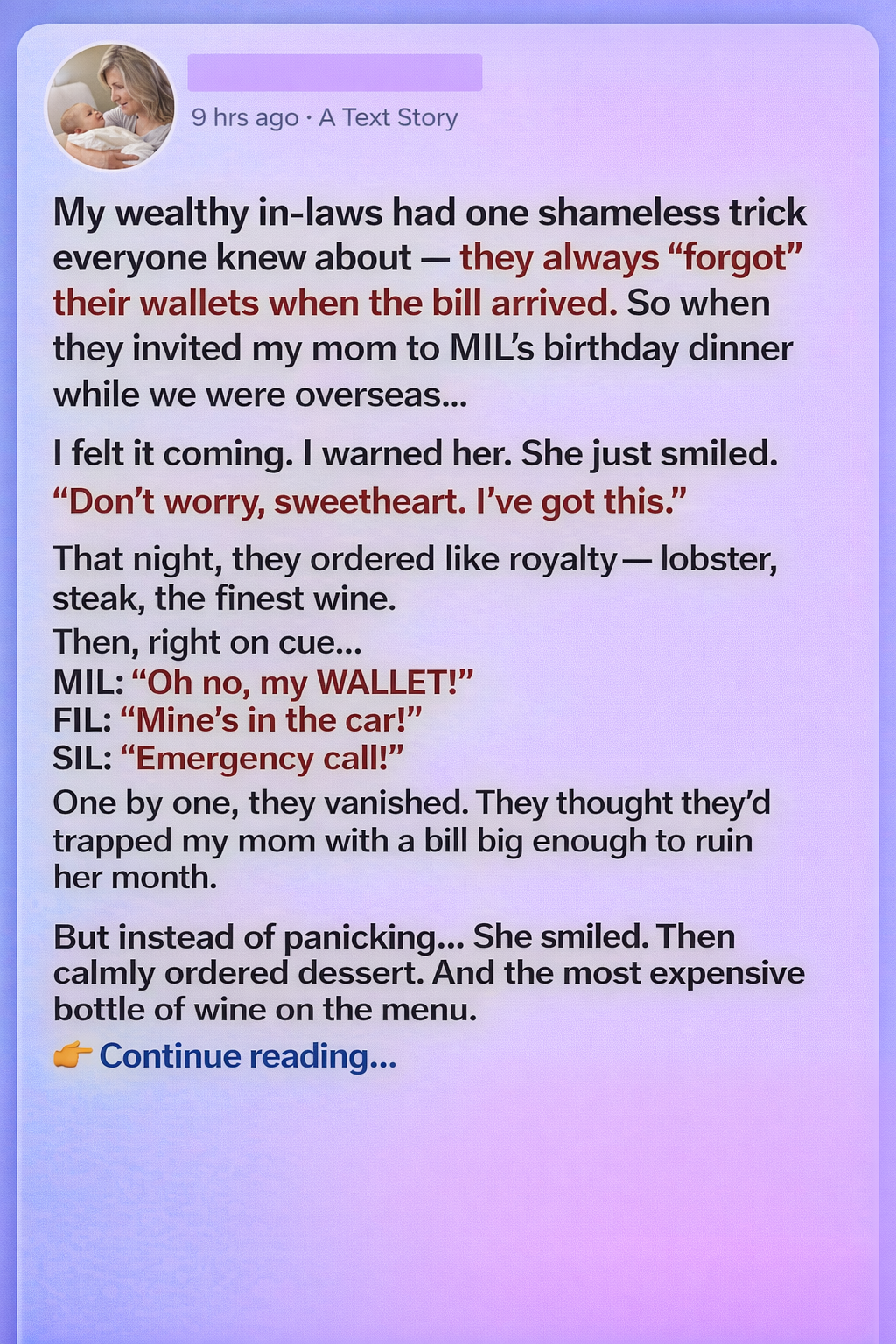
My wealthy in-laws had a habit so shameless it almost felt rehearsed.
They loved expensive restaurants. Not casual places — I’m talking white tablecloths, wine lists thicker than novels, servers who described the fish like poetry.
They ordered lobster, premium steaks, imported wine.
But when the check arrived?
Suddenly, wallets disappeared.
My mother-in-law would gasp dramatically.
“Oh no, my wallet!”
My father-in-law would stand up.
“I left mine in the car.”
My sister-in-law would glance at her phone.
“Emergency call.”
And somehow, someone else at the table always paid.
No one ever confronted them directly. People just… absorbed it. Quietly resentful. Too polite to cause a scene.
So when they invited my mom to my mother-in-law’s birthday dinner while my husband and I were overseas, I felt sick.
“Mom… please be careful,” I told her. “You know what they do.”
She laughed softly.
“Sweetheart. I raised you. I can handle dinner.”
That night, they went all out.
Lobster tails. Aged ribeye. Two bottles of their most expensive wine. Dessert for the table.
My mom kept it simple — a salad and iced tea.
Then, like clockwork, the performance began.
“Oh no, my WALLET!” my mother-in-law exclaimed.
“Mine’s in the car,” my father-in-law added quickly.
“Emergency call!” my sister-in-law announced, already halfway out of her chair.
One by one, they slipped away.
They left my mom sitting alone with a bill close to $900.
The waiter hovered awkwardly. The restaurant was busy. Other tables were watching.
Most people would have panicked.
My mom didn’t.
Instead, she smiled and said to the waiter, “Oh, that’s fine. I’ll be adding a few things.”
She ordered dessert.
Then she asked for the most expensive bottle of wine on the menu — the one my in-laws had admired earlier but decided was “too much.”
The waiter hesitated.
“Are you sure?”
She nodded.
“Absolutely. And could you also let the manager know I’ll be settling the entire bill personally?”
Ten minutes later, the manager came over. My mom calmly explained that she had been invited as a guest and that the hosts had stepped away.
The manager sighed.
“We’ve had… similar issues with this party before.”
That told her everything.
She paid the full bill — including her new additions — with her credit card.
But she wasn’t finished.
Before leaving, she asked for itemized receipts. Plural.
The next morning, my in-laws woke up to something they weren’t expecting.
My mom had mailed each of them a copy of the receipt — with their individual items highlighted.
Attached was a short, polite note:
“Since you accidentally left without paying for the dinner you hosted, I’ve taken care of it. I’ve highlighted what each of you ordered. You can reimburse me directly. I’ve also included gratuity.”
No insults.
No drama.
Just numbers.
My father-in-law called first — furious.
“How dare you embarrass us like this?”
My mom’s voice was calm.
“I didn’t embarrass you. I covered your bill.”
Within three days, every cent was transferred back to her account.
No apology.
But something better happened.
They never pulled that stunt again.
Not at family dinners. Not with friends. Not ever.
Word quietly spread among relatives about what happened that night. Invitations became clearer. Bills were split upfront. Miraculously, wallets were never “forgotten” again.
When my husband and I returned home, I asked my mom why she paid the whole thing instead of just her portion.
She smiled.
“Because sometimes the only way to stop a pattern is to make it expensive.”
To this day, my in-laws are careful — almost overly careful — whenever a check arrives.
And my mom?
She keeps that receipt in a folder labeled:
“Lessons.”