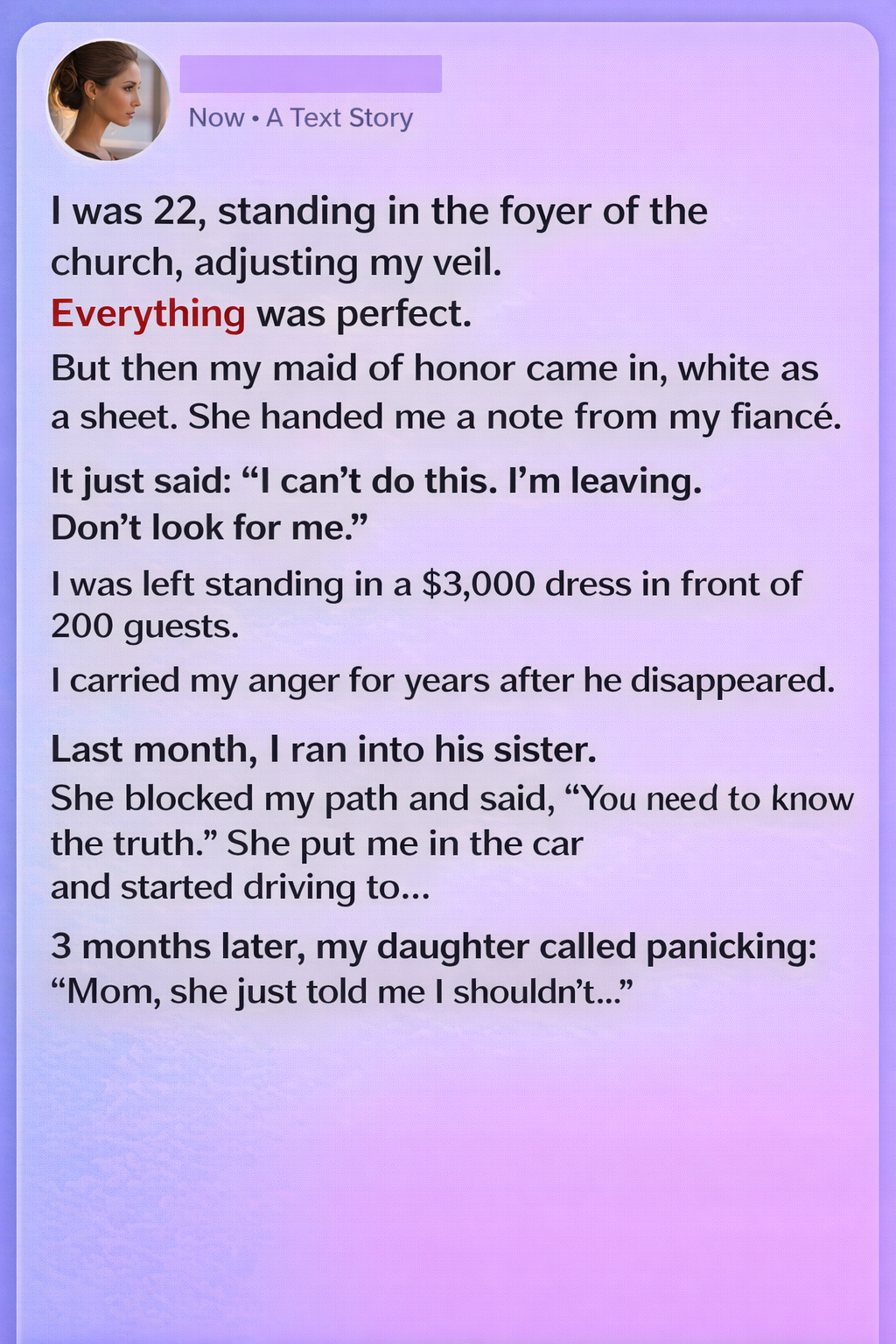
I was 22, standing in the foyer of the church, adjusting my veil.
Everything was perfect. The flowers were arranged, the music was soft and steady, and 200 guests were seated inside waiting for me to walk down the aisle. My dad had just kissed my forehead. My mom was crying happy tears.
Then my maid of honor rushed in.
Her face was drained of color.
She handed me a folded piece of paper.
“It’s from him,” she whispered.
My hands trembled as I opened it.
“I can’t do this. I’m leaving. Don’t look for me.”
That was it.
No explanation.
No apology.
No signature.
Just four sentences that detonated my entire future.
I remember the silence first. Then the noise. The whispers spreading like wildfire through the church. My mother collapsing into a chair. My father demanding answers no one had.
He was gone.
Phone off. Car missing. No trace.
I stood there in a $3,000 dress, mascara running, while guests quietly slipped out the side doors to avoid eye contact.
Humiliation doesn’t even begin to cover it.
For years, I carried that abandonment like a scarlet letter. I told myself he was weak. Cowardly. That I had dodged a bullet.
I rebuilt.
It took time. Therapy. Moving to a different city. Changing jobs. Changing everything.
Eventually, I married someone else — a steady, kind man named Daniel who knew my history and never flinched at it. We had a daughter, Lily. She became my world.
I thought that chapter of my life was sealed.
Until last month.
I was leaving the grocery store when someone called my name.
I turned and saw his sister.
Emily.
We hadn’t spoken in over a decade.
She looked older. Tired. Determined.
“You need to know the truth,” she said.
I almost walked away. But something in her voice stopped me.
She asked me to get in her car. Against my better judgment, I did.
She didn’t drive far — just to a quiet park nearby.
Then she told me something that shifted everything I thought I knew.
He hadn’t left because he got cold feet.
He hadn’t cheated.
He hadn’t changed his mind.
Two days before the wedding, he’d gone to the doctor for chest pain. It turned out to be a congenital heart condition — severe and unpredictable. The doctor told him he might need surgery and that there were risks. Serious ones.
He panicked.
He told Emily he couldn’t marry me knowing he might die young or leave me widowed with debt and medical bills.
“He thought he was protecting you,” she said softly.
I felt anger rise.
“By humiliating me in front of 200 people?”
“He said if he told you, you’d insist on staying. And he didn’t want you choosing a hard life.”
He left town for treatment. Multiple surgeries. Complications.
He survived.
But by the time he was stable, I had already moved on.
He never reached out.
“He said you deserved a clean break,” Emily said. “And he didn’t think you’d forgive him.”
I didn’t know what to feel.
Relief?
Fury?
Grief all over again?
Then Emily said something else.
“He’s not well again.”
Three months after that conversation, my daughter Lily called me from school, her voice shaking.
“Mom, she just told me I shouldn’t ever run away from someone who loves me because I’m scared.”
I froze.
“Who told you that?”
“Mrs. Carter. The substitute.”
Mrs. Carter.
Emily.
She had become a substitute teacher at Lily’s school.
Later that afternoon, I met her outside the building.
“I didn’t tell her details,” she said quickly. “But I told her fear makes people do stupid things.”
I looked at her and realized something painful.
We were all still living inside the consequences of that day.
I eventually agreed to see him.
He looked thinner. Slower. But his eyes were the same.
“I thought I was doing the right thing,” he said. “I thought loving you meant leaving.”
“You didn’t give me a choice,” I replied.
He nodded. “That’s my regret.”
We didn’t rekindle anything.
We didn’t rewrite history.
But we talked. We closed the door properly this time.
Forgiveness isn’t about excusing someone. It’s about releasing yourself from the weight.
He passed away eight months later from complications.
Emily called me.
I cried — not for what we lost, but for what fear stole from both of us.
When I got home that night, I hugged Daniel tighter. I told Lily the truth — age-appropriate but honest.
“Sometimes adults make bad decisions because they’re scared,” I told her. “But the brave thing is staying and facing it.”
The wedding day that once defined me no longer feels like a humiliation.
It feels like a turning point.
He didn’t leave because I wasn’t enough.
He left because he was afraid.
And I built a life anyway.